
By Peter Pavarini
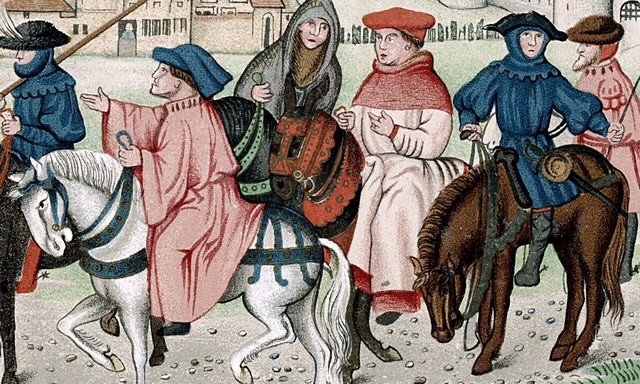
In my senior year of high school, I took an AP English class that had an arduous memorization requirement. Each week, I was expected to memorize a poem or other passage of English literature and recite it before my classmates with no mistakes. Other than one well-known Shakespearean sonnet, the only literary fragment I still remember are the first eighteen lines of the prologue to Geoffrey Chaucer’s The Canterbury Tales – in Middle English no less.
A Seminal Piece of English Literature
For those who never read The Canterbury Tales, they are a collection of twenty-four stories told by a diverse cast of characters making the 60-mile pilgrimage from London to the shrine of Saint Thomas Becket in Canterbury. The simple plot provides a framework for exploring the human condition through a series of stories told by the pilgrims in the form of chivalric romances, bawdy tales, moral allegories and sermons.
The Canterbury Tales take place entirely at the Tabard Inn, a coach stop in Southwark, England along the ancient Roman road which connects London Bridge with Canterbury Cathedral. Built around the year 1300, the inn stood in various forms until the 19th century when it burned to the ground and was not replaced. The site is marked by a simple sign on the corner of a street named Talbot Yard.
Harry Bailey, the Inn’s owner, serves as the moderator of The Canterbury Tales. He challenges his guests to a storytelling contest; the prize being a free meal upon the return from their pilgrimage. The Tales begin in the month of April when Chaucer tells the reader that the “tendre croppes and the yonge sonne hath in the Ram his half cours yronne”.[i]
Although The Canterbury Tales offer a fairly accurate depiction of Medieval society in the late 1300s, the work’s symbolism remains applicable to today’s world – blending themes of nature’s rebirth in the Springtime with the spiritual awakening of Easter. Scholars generally consider The Tales to be a cornerstone work which shaped how we speak English today.
Pilgrimages Past and Present
Personally, I’ve never been on a pilgrimage. I have, however, visited several religious destinations such as the Holy Land and the Vatican. Recently, many of my friends have made the popular Camino de Santiago pilgrimage in Spain. During the Middle Ages, making a pilgrimage was a core expression of Christian piety – a way to fulfill one’s vows, seek healing or perform penance. Places like Lourdes, Guadalupe and Canterbury remain favorite pilgrimage destinations for many Christians today. Those of other faiths make similar journeys. Muslims perform the Hajj pilgrimage to Mecca, Buddhists travel to India’s Bodh Gaya, and Hindu pilgrims practice the Kumbh Mela at one of four locations in India. Some of these journeys are considered arduous, involving barefoot travel and self-depravation; others are simply a mix of religious devotion and adventure.
The Importance of Storytelling
But it’s not the pilgrimage but the storytelling in The Canterbury Tales that I wish to focus on. From a literary perspective, the Tabard Inn represents the gateway from secular London to sacred Canterbury – a portal where the banalities of life yield to the transformative effects of storytelling. By having the pilgrims travel together, share lodging and meals, the pilgrimage removes the traditional barriers between social classes (a knight, a miller, a prioress, a pardoner, etc.). At least temporarily, the hierarchal structure of Medieval society is suspended, and each person shares the same humanity through the custom of storytelling.
The stories told in The Canterbury Tales are meant to be more than entertainment. They are an integral part of the pilgrims’ journey. By telling their stories, the pilgrims instruct, confess and contest truths from their everyday lives. Ironically, the tales are able to blend spiritual piety with bawdy tales of greed, sexuality, and folly. It’s as though Springtime’s reawakening fueled the pilgrims’ religious zeal as well as their worldly desires. Because their storytelling combines vivid realism and enduring literary symbolism, The Canterbury Tales can either be read as a corrective satire or as a celebration of human nature.
We Are All Born Storytellers
Human beings are natural storytellers. As often said, in every person there is a storyteller waiting to be released. Before languages were written, oral stories were the primary way a tribe’s accumulated wisdom passed from one generation to the next. Even now, with the availability of unlimited forms of digital communication, oral storytelling remains the foundation on which many communities are formed and stay together.
In his classic novel East of Eden, John Steinbeck wrote:
“If a story is not about the hearer, he will not listen … A great and lasting story is about everyone, or it will not last. The strange and foreign is not interesting – only the deeply personal and familiar.”[ii]
The road to Canterbury is said to be a metaphor for the human condition – a journey marked by hope, conflict and transformation.[iii] Tales told by the pilgrims foster a sense of community and provide a space for self-discovery. Behind the messiness of their earthly lives, there are eternal souls yearning to be restored to their intended condition.
In the words of Southern writer Flannery O’Connor:
“There is something in us, as storytellers and as listeners to stories, that demands the redemptive act, that demands that what falls at least be offered the chance to be restored.”[iv]
A Space Age Journey
As I write this, Americans are celebrating the feel-good story of Artemis II’s journey to the Moon and back. In making the first crewed mission to our closest neighbor in over 50 years, the four astronauts reminded us of what humanity, acting with confidence and purpose, can still do.
Numerous surveys indicate how much American society has changed since the Apollo missions of the 1960s and 1970s. We’ve become politically more divided, distrustful of our institutions, and not very good at having lasting marriages or raising children. The optimism which propelled us into space a half century ago has been replaced by a malaise that makes us more cautious, suspicious and unwilling to take risks. The same factors were probably present in the late 1300s when twenty-nine pilgrims began their journey to Canterbury. Their distrust of the ruling class, the church, and feudal economy as well as their memory of a plague that recently killed up to one third of the European population – surely rivaled anything we face in modern society.
Yet, the tale of three previously unknown Americans and one Canadian making a 10-day journey around the Moon present us with a powerful counternarrative to the pessimism, wokeism and spiritual ambiguity of the times. Hearing the astronauts’ personal stories of their daring journey into space reawakened our confidence and hope for a brighter future. Unexpectantly, the Artemis II mission united Americans of all political, religious, racial and ethnic stripes notwithstanding the paucity of coverage given by the mainstream media until just a few days before the launch.
Like The Canterbury Tales, the Artemis II mission resonated with ordinary folks – not so much because of the journey’s difficulty or technical achievements, but more because of the emotional impact it had on its four astronauts. Each crew member expressed in vivid terms how they were transformed by seeing Earth from a distance. Mission pilot Victor Glover may have said it the best:
“In all of this emptiness – this whole bunch of nothing we call the universe – you have this oasis; this beautiful place we call Earth that we get to exist in together.”[v]
It’s that kind of unity that makes us all pilgrims on the same road we call life.

[i] Translation: The tender new leaves and the young sun has run half its course through the Zodiac sign of Aries.
[ii] East of Eden, Viking Press (1952).
[iii] A. H. Ahman, “The Concept of Road in Medieval English Literature”, https://doi.orh/10.5281/zenodo (2025)
[iv] Mysteries and Manners: Occasional Prose (1970)
[v] Chrissy Callahan, “Artemis II Astronaut’s Reflection of His Faith From Space Is Moving People on Earth”, April 8, 2026, Today.com.
Be First to Comment