
By Peter Pavarini
Coming home from a dinner meeting recently, I noticed it was still light outside despite being almost 9 pm. Since we’re approaching the summer solstice here in Ohio, I shouldn’t have been surprised that the days are now nearly 15 hours long. But, being a morning person, I knew my circadian rhythm would be awakening me in a few hours.
I haven’t always been a morning person. For most of my life, I had to set an alarm to be on time for school or work. Then, in my early 40s, two things happened in quick succession. I got a dog, and I read Julia Cameron’s The Artist’s Way.[i] Owning a dog probably needs no explanation, but unless you’ve read the book, you might not appreciate how it pertains to getting up before the crack of dawn. Briefly, Julia Cameron’s best-selling guide to “connecting with one’s inner artist” requires her readers to generate three pages of stream-of-consciousness writing every morning – without fail. I knew I couldn’t do that without adjusting my schedule.
At first, I only set my alarm 30 minutes earlier but gradually found myself arising one to two hours sooner than what had been my normal wake-up time. Once I discovered the quiet joy of those early morning hours, I no longer needed to set an alarm. I became my own human alarm clock.
Early Birds, Owls, Bears and Dolphins
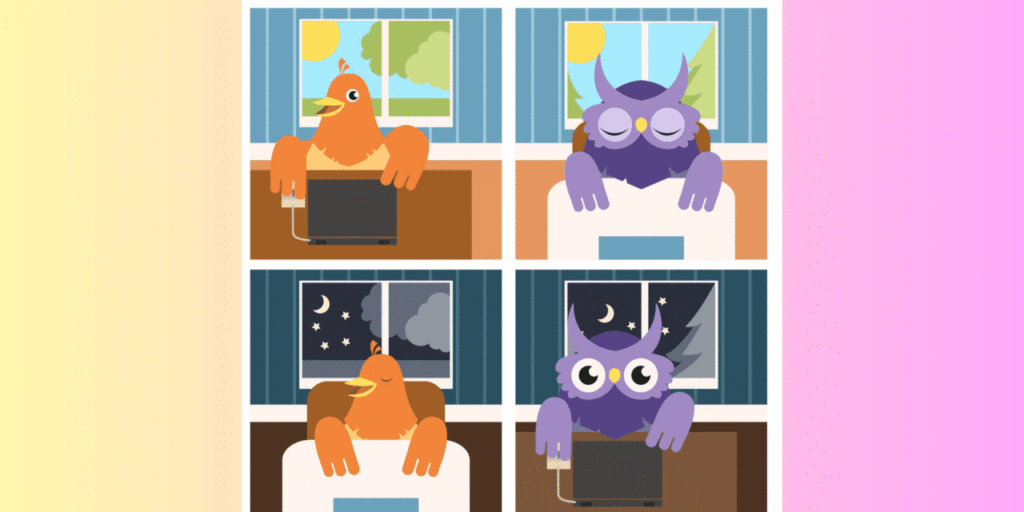
It’s hard to find a personality trait that has been studied more than whether someone is an “early bird”, “night owl” or something else. According to those who specialize in sleep and personality types, individuals who regularly go to sleep between 9 and 10 pm and get up between 4 and 6 am are generally seen as “early birds”, “larks” or simply “morning people”. They constitute between 10 and 25 percent of the population, depending upon how you categorize everyone else. In contrast, “night owls” (also about 10 to 25 percent of the people), are inclined to stay up past midnight and prefer waking up late – well after the sun has risen. The rest of us are either “bears”, whose sleep cycles track more closely with the Earth’s cycle of light and darkness, or “dolphins” who sleep erratically or very little – this group includes insomniacs.
Chances are you already know your “chronotype”. But in case you don’t, there are numerous articles, blogs and psychological studies to help you determine where you fall.[ii] As the foregoing chronotypes relate to health, productivity and other indicators of wellness, being a morning person clearly is the preferred classification. Research shows that such people are happier, more optimistic, more punctual, communicate better, and do better in school. Morning people are also less likely to suffer from depression than others of the same age, gender or other demographic group.[iii] Evening people, on the other hand, are said to be more creative, more impulsive, and more adaptable to working longer or unpredictable hours[iv]. Unfortunately, those traits also make them more likely to develop addictive behaviors[v], antisocial tendencies[vi], and to remain single instead of being in a long-term relationship.[vii]
Genetic Evidence for Differences Between the Chronotypes
Is a person’s chronotype a personal choice or a genetic predisposition? I’ve always been somewhat suspicious of psychological theories based on highly subjective observations or just “conventional wisdom”.
So, looking deeper into this subject, I found a fair amount of scientific evidence to support why people fall into one chronotype or another. The so-called “clock gene” – PER3 – has been identified as a critical determinant of one’s sleep cycle.[viii] If your PER3 genes tend to have longer alleles, you’re more likely to be a morning person. If those alleles are shorter, then you’re more likely to be an evening person. Bear in mind, however, geneticists also say there could be as many of 43,000 other DNA markers associated with a person’s chronotype.[ix] So, who knows?
Other Factors Affecting Chronotype
Although some commentators say there’s nothing you can do to change your chronotype[x], there certainly appear to be other factors that determine why people have the sleep/waking cycles they have. Some of these are geographic[xi]; some are purely cultural. Consider those societies in which having the largest meal of the day after 10 pm is seen as perfectly normal. In those cultures, staying up until the wee hours and sleeping in the next day are not only done on weekends. Of course, those societies also expect shopkeepers to close their businesses in the middle of the day, go home for lunch and take a siesta.
Much has been written about the impact the introduction of electric light had on modern society[xii]. More recently, others have expressed a growing concern about the effect excessive “screen time” has on our natural circadian rhythms[xiii].
Why Your Chronotype May Determine Your Worldview
Before writing this blog, I reviewed numerous articles from a variety of sources across the political spectrum. I was struck by the high correlation between an author’s apparent politics and preference for when people should be asleep or awake.
For example, Haley Weiss, a writer for Time Magazine, asked whether sleep research presented an “overly moralistic picture”.[xiv] Citing a study done by a group of Polish researchers, the Time writer reported that the long-established link between being an early riser and being conscientious had more to do with being religious than anything else. Imagine that!
“Morningness might be closely aligned with godliness, in part because certain religions practice early-morning prayer – so religion could be driving the link between rising early and being conscientious. . . Of course, religion might be just one under-examined variable that contributes to the link between sleep and waking behavior. Countless more exist.”[xv]
To someone who sees the world in relativistic terms, the “morning bird/night owl divide” might seem “too stark” – just like the male/female divide or other binary classifications. As Ms. Weiss commented:
“Just remember: You don’t have to be a morning lark or a night owl. You can be any kind of bird you like – there are plenty of worms to go around.”[xvi]
The Politics of Sleep
With the help of artificial intelligence, I discovered that a study of seven American samples and one British sample found a link between chronotypes and political ideology. This finding was subsequently validated in a study across 10 nations.[xvii]
“Morningness” is a reliable predictor of conservatism while “eveningness” reliably predicts liberalism. This conclusion holds true even when controlling for personality traits (such as openness and conscientiousness) and demographics (age, sex, income and education). Factors like urbanization, geography and religious denominations were also considered but don’t appear to alter this finding. However, in both of the aforementioned studies, the regularity of one’s religious observance was unquestionably shown to be a proxy for conservatism.
It’s indeed fascinating to see how the psychology of sleep intersects with the formation of someone’s political views. Sleep politics may soon become the key which unlocks the mystery why people vote the way they do.
[i] Julia Cameron, The Artist’s Way: A Spiritual Path to Higher Creativity, Penguin Books (1992)
[ii] A good place to start is the bibliography in Morning or Night Person | AncestryDNA® Traits Learning Hub.
[iii] Sarah Klein, Seven Things Morning People Do Differently”, Huffington Post, April 1, 2014.
[iv] Among others, evening workers include those who work in restaurants, entertainment, personal care and emergency services.
[v] F. Scott Fitzgerald, one of my favorite authors, was known to be a night owl, but he died at age 44 after a long history of alcoholism.
[vi] There are many famous (and some infamous people) in the night owl group, including Adolf Hitler, Joseph Stalin, Barack Obama, Charles Darwin, Winston Churchill and Bob Dylan.
[vii] A 2002 study by Delroy Paulhaus and Kevin Williams gave birth to the psychological theory known as the “dark triad”. The three personality types of Machiavellianism, narcissism and psychopathy show a high correlation with “eveningness”. Melissa Burkley, “So Psychopaths Prefer the Night?”, Psychology Today, March 10, 2020.
[viii] “PER3 Period Circadian Regulator – Gene ID: 8863, updated April 8, 2026, https://www.ncbi.nlm.nih.gov/gene/8863 .
[ix] P. Dutta, “The Science of Morning People and Night Owls”, www.ultrahuman.com, March 17, 2022; D. Pacheco, “Chronotypes: Definitions, Types & Effects on Sleep”, www.sleepfoundation.org, July 10, 2025.
[x] Brian Resnick, “If You’re Not a Morning Person, Science Says You May Never Be”, vox.com, March 17, 2017.
[xi] Night owls are more common the closer you get to the poles. Early birds are more common the closer you get to the equator.
[xii] I highly recommend Graham Moore’s historical novel The Last Days of Night, Random House (2017) for an entertaining thriller about the battle to electrify America in the late 1800s.
[xiii] E.g., S. Muppalla, et al, “Effects of Excessive Screen Time on Child Development: An Updated Review and Strategies for Management”, June 18, 2023, https://pmc.ncbi.nlm.nih.gov
[xiv] Haley Weiss, “Why Waking Up Earlier Isn’t Necessarily Better”, Time Magazine, May 25, 2023.
[xv] H. Weiss, supra.
[xvi] H. Weiss, supra.
[xvii] Aleksander Ksiazkiewicz, “Conservative Larks, Liberal Owls: The Relationship between Chronotypes and Political Ideology”, University of Chicago Press (2020).
Be First to Comment