
By Peter Pavarini
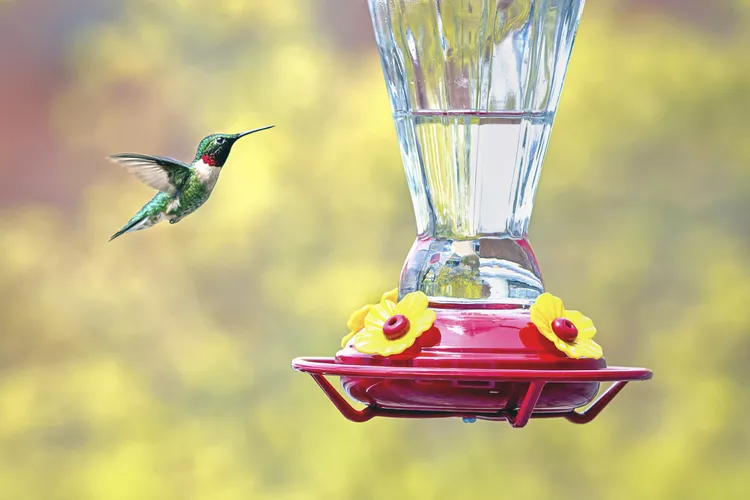
I recently thought I saw a new bird species at my backyard hummingbird feeder. But Grok quickly informed me that these birds were just juvenile ruby-throated hummingbirds left behind by their parents already on their way to Central America. Ever the animal lover, I asked how could Nature ever allow such a terrible thing to happen?
As it turned out, the youngsters hadn’t been abandoned. They were just taking their sweet time feeding heavily before catching up with their folks on that thousand-mile journey. Traveling at speeds of almost 40 miles per hour, these tiny iridescent birds – the smallest of all bird species – can make a nonstop flight cross the recently renamed Gulf in a single day. With wings beating up to 80 times a second and a heart rate of nearly 1,200 beats a minute, a hummingbird’s energy requirements are comparable to a gas-guzzling car in the era of twenty cent gasoline.
Powering a Hummingbird’s Hyperactivity
These ornithological wonders need lots of fuel to hover in place, fly backwards, sidewards as well as forward. When not feeding, they effectively shut down by going into torpor – a near comatose state in which their body temperatures dramatically drop to conserve energy. That explains why hummingbirds – whether young or old– need to build up their fat stores before making an incredibly long trip away from Ohio’s winter.[i]
If a hummingbird survives its first year (half of them do not), their typical life expectancy is 3 to 5 years. During this life span they will make multiple round trips of 2,000 miles or more to a tropical paradise like Guatemala. Despite that, they always remember to return to the same dependable sources of nectar, including backyard feeders like the one which prompted this blog.[ii]
Navigating By the Stars
But I still wanted to know why mature hummingbirds would leave their offspring alone to make such an arduous trip to a place they’ve never been? I learned that mature males are always the first to leave a breeding area (not a surprise). In Ohio, these daddy birds often leave as early as July to stake out the best winter Airbnbs in the cloud forests of Central America. Mature females depart after that, leaving their offspring by early September. Only the juveniles remain to fill their bellies before instinctively using the stars to navigate their way to warmer climes.
Notwithstanding folk wisdom, hummingbirds do not migrate south on the backs of Canada geese. If that were ever true, today’s trade wars make the practice unworkable. Nor do hummingbirds migrate in flocks[iii]. All of them fly solo when making these incredibly long trips. While still over America’s southern states, they only stop to refuel on nectar that still flows there during the fall months.
The Migratory Patterns of Humans
Everything I’ve learned about migratory birds makes me ask: are humans much different than our feathered friends?
Since humanity began leaving our ancestral home in Africa about 300,000 years ago, we too have wandered countless miles in search of better weather and more dependable resources. At first, such migration was mostly accidental. Our ancestors were just following a herd of animals that had been their primary source of nutrition. Later, humans began leaving for other reasons – to trade goods, find work and escape adverse conditions like war, famine and pestilence.
In modern times, more mature members of the human species have taken up the practice of spending their golden years in places with temperate winters, such as Florida, Texas and Arizona. This trend gave rise to the term “snowbird”, what the natives of such states euphemistically call these northern visitors. Each fall, snowbirds get in their cars and RVs before the winter sets in and drive hundreds of miles, only stopping to refill their bellies and gas tanks at establishments like Bucee’s.[iv]
More recently, this migratory pattern has also been embraced by younger members of the human species. Following in the footsteps of their elders, they have populated America’s Sunbelt and pioneered new communities in the Caribbean and Central America offering lower taxes, more affordable housing and less government regulation. Unlike their parents, however, many of these juveniles have chosen not to return to the northern states when spring arrives. Like some bird species, they’ve decided to become permanent residents of such favored locations.
Accidentals and Other Migrants
In the case of both birds and humans, there are some notable exceptions to foregoing categories of migrants. As every birdwatcher knows, some birds are classified as “accidentals” when they show up well outside their normal range. If you’re working on your “life list”, it’s a red-letter day when you find an exotic bird visiting your backyard.
Accidentals show up for various reasons. Most often, weather events like powerful storms or cold fronts push migratory birds off course. Apart from bad weather, birds also make navigational errors when travel conditions aren’t consistent with their internal programming. Increasingly, however, human intervention is to blame. Exotic birds sometimes accidentally wind up in shipping containers, or they are illegally removed from their native homes by smugglers and tourists.
How Native Birds Respond
How do native birds respond when accidentals come into their territories? The avian response depends upon the invader’s appearance and whether it competes for the same resources. For example, if an accidental bird looks or sounds like a native species, it will immediately encounter intense territorial aggression. This is especially true during the spring breeding season. Native birds will dive-bomb, chase and otherwise clash with the migrant expecting to drive it away.
At a local food source like a backyard bird feeder, native birds will enforce the local hierarchy by bullying or displacing any accidental visitor. If the accidental is a large raptor, even relatively meek species like chickadees will band together, emit loud alarm calls and repeatedly dive at the accidental predator until it leaves the area.
How Humans Respond to Migrants
Obviously, in the context of human migration, it is tempting to make analogies to the behavior of birds. Human history is filled with many examples of intentional invasions as well as the gradual movement of people looking for better living conditions. Nations like the United States of America were largely populated by such immigrants. However, none of these migrations can be seen as “accidental”. Whatever reasons they have for moving, humans are generally deliberate.
What makes today’s mass immigration out of underdeveloped regions into the developed nations of the West so controversial is its nonconsensual nature. Unlike birds which have been blown off course, these migrants are being injected into modern societies by geopolitical interests that don’t seem to care what native populations think. We should not be surprised, therefore, when we hear reports of skirmishes around the human “backyard feeder”.
In 1972, the pop duo Seals & Crofts had a number one hit named “Hummingbird”. It was a welcome respite from the Vietnam war, gas lines and other tensions of the time. I’ll end with a taste of the nectar of that song:
Oh hummingbird, mankind was waiting for you to come flying along
Heavenly songbird, we were so wrong.
Oh hummingbird, lend us your wings.
Lift us up to the heaven of holiness, oh source of our being.
Hummingbird don’t fly away fly away
Haven’t you noticed the days
Somehow keep getting longer?
And the Spirit voices whisper in us all.
Haven’t you noticed the rays? The Spirit sun is stronger.
And a new day is dawning for us all.[v]
[i] Only warblers make longer journeys – many wintering in South America.
[ii] Notwithstanding their tiny size, hummingbirds have large brains compared to other bird species. They seem to recognize individual humans, especially those who always refill their feeders every few days.
[iii] A group of hummingbirds is called a “charm”.
[iv] I’ve also been told that some also stop every 200 miles to recharge their e-cars.
[v][v] Written by Darrell Crofts, Jimmy Seals (Clear Box Rights LLC, 1972).
Be First to Comment