
By Peter Pavarini
I celebrated Y2K by helping my two sons assemble a time capsule of things they felt characterized growing up in America during the late 20th Century. As I recall, the time capsule contained their handwritten letters to the future, a cassette tape of popular music they were listening to at the time, a few Legos, at least one Beanie Baby, and other mementos of the Game Boy era.
While we were involved in that project, the bridge across a small creek on our property washed out in a storm and needed to be repaired. I turned the unfortunate occurrence into an opportunity to encase the boys’ time capsule in the concrete being poured for the new bridge. I later affixed a brass plaque to the bridge telling future generations where the time capsule had been buried.
Twenty-six years have since passed. Our sons are now grown. We sold the home we were then living in a while ago, but as far as I know, the time capsule is still there waiting for someone to open it and have a laugh or two about its contents.
A Relatively Modern Concept
To my surprise, time capsules[i] are a relatively modern concept. Before the 20th Century, human lifespans were much shorter than they are today and preserving memorabilia for future generations wasn’t done very often – at least not intentionally. The introduction of photography in the mid-19th Century changed that because it gave people an easier way to leave a record of what they looked like to their posterity.
Anna Deihm’s Century Safe
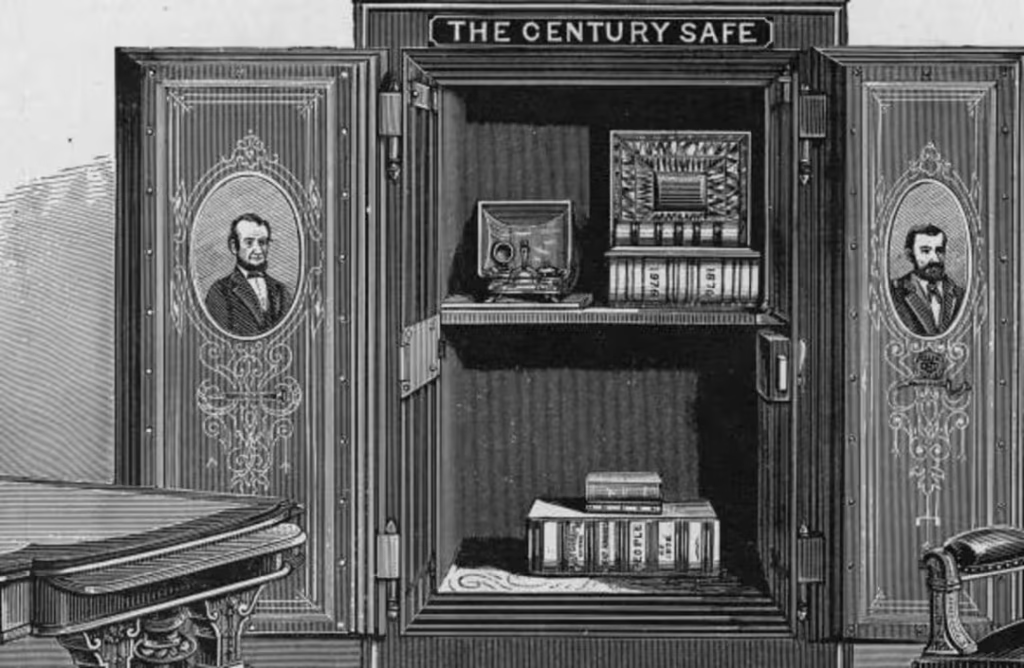
One of America’s first official time capsules was put together in connection with America’s celebration of its Centennial in 1876. An entrepreneurial Civil War widow named Anna Deihm conceived of having a large iron safe serve as a living archive of American culture. As a New York publisher, she also wanted to promote her new magazine Our Second Century. At great personal expense, this patriotic lady arranged to have what she called the “Century Safe” shown at the Centennial Exposition in Philadelphia[ii]. Visitors to the event were invited to contribute photographs, autographs and other mementos of the time to her time capsule.
The 3500-pound safe stood roughly six feet tall, had a volume of 70 cubic feet, was lined in velvet and ornately engraved. The inscription on its heavy steel door said the safe should remain locked until July 4, 1976, when it could only be opened by whomever was serving as President of the United States at the time. After the Exposition was over, the Century Safe was ceremonially sealed by President Rutherford B. Hayes in 1879, exhibited in the Capitol’s Statutory Hall for a time, then housed in the East Portico, until it eventually became part of the Smithsonian’s collection where it was all but forgotten.
Rediscovery of the Century Safe
When plans for the Nation’s Bicentennial took shape in the early 1970s, the Century Safe was rediscovered. The Smithsonian hired a locksmith to open the safe’s outer door but kept its inner glass doors sealed until a distant relative of Anna Deihm furnished the original key. Then, on July 1, 1976, President Gerald Ford presided over the opening of the time capsule in the Capitol with members of both Houses in attendance.
The safe opening ceremony turned out to be somewhat of a dud.[iii] Not knowing what he’d find in the safe, Ford delivered a few prepared remarks[iv] but seemed tongue-tied when it came to describing its contents. Inside the safe was a Mathew Brady portrait of President Ulysses S. Grant (who had been President in 1876), a variety of political memorabilia and a large album signed by the Members of Congress and over 80,000 government employees.[v] There was also a gilded pen belonging to poet Henry Wadsworth Longfellow and several publications, including an early temperance manual. But sadly, the Century Safe contained nothing that depicted what life was like in the 1870s or was otherwise missing from the Smithsonian’s archives.
What the Century Safe Could Have Contained
To be fair, the America of 1876 was still in the Age of Steam. Edison had yet to invent the light bulb and most American homes were illuminated by whale oil or natural gas. Few of the inventions that later turned America into an industrial giant were in commercial use by then. Although Alexander Graham Bell did demonstrate a prototype of his telephone at the Philadelphia Exposition, news of the day was still communicated on paper or by telegraph. New technologies like the Remington typewriter and an improved version of the sewing machine were also exhibited in Philadelphia, but apparently no one thought to contribute examples of them to Anna Deihm’s safe.
Despite being seen as a bust, the opening of the Century Safe in 1976 didn’t dissuade others from sponsoring more ambitious time capsules in preparation for the country’s Tricentennial in 2076. My favorite is the one that was buried by an 86-year-old hardware-store owner in Nebraska. It’s said to contain a 1975 Chevy coupe, a Kawasaki motorcycle, a Teflon frying pan, a bolt of polyester fabric, a pair of bikini panties and a man’s aquamarine “leisure suit” complete with stitched yellow flowers.[vi]
Celebrating America’s 250th Anniversary
In view of the foregoing history, I’ve been wondering how we should be commemorating America’s 250th anniversary. While writing this blog, I learned that America250, the nonpartisan organization commissioned by Congress to direct the celebration, is expecting to bury a time capsule in Philadelphia’s Independence Hall Park – one that won’t be opened until the Nation’s 500th anniversary in 2276. To avoid the disappointment of Anna Deihm’s Century Safe, America250 has arranged to have the 900-pound stainless steel cylinder[vii] stuffed with more than 200 high-tech items and curiosities from the country’s first 250 years. This collection includes:
- An Apple iPhone 17 Pro Max
- A microscopic data storage device containing synthetic DNA which holds digital copies of Thomas Jefferson’s draft of the Declaration of Independence, a 3D rendering of Abraham Lincoln’s hand, and an 1898 audio recording of the National Anthem
- An Olympic gold medal
- Native American artwork
- Student essays from America’s Field Trip contest
- A feather from a Civil War-era bald eagle
- A Coca-Cola bottle housing the sheet music for “I’d Like to Buy the World a Coke”
- A handheld flag from the 2026 Rose Bowl Parade
The Importance of Time Capsules
It may be that time capsules and other commemorative efforts never mean as much to future generations as they do to those who create them. Every memorial – from a weatherbeaten tombstone in an overgrown cemetery to the most elaborate marble monument in a capital city – is erected with the hope that people not yet born will find a reason to care about the past.
I honestly don’t know whether the United States of America will still be a country 100 years from now, much less in 250 years. Consequently, I may not have Anna Deihm’s confidence in the future. Historians say the Roman Empire lasted a total of 1,480 years but only if you consider numerous changes in its size and system of governance. By comparison, no modern democratic republic has lasted longer than the United States. To achieve that, we’ve also experienced civil war and repeated revisions to our constitutional framework.
The Character of Those Who Bury Time Capsules
Those who bury time capsules are said to be either optimistic or selfish. Optimistic because they naively think people in the future will care about the past or want to learn from it. Selfish in the sense that seeking to insert oneself into someone else’s future is at best a vanity project.
I don’t see them either way, however. At the present time, the future belongs to no one. Whether you’re young or old, there’s no assurance you will ever get a chance to occupy it. Therefore, I contend we’re all free to leave evidence of whatever hopes and dreams we now have for a future that will be made better if we dare to live our present lives fully.
[i] As opposed to unintentional repositories of ancient things archaeologists seek.
[ii] The first major world’s fair hosted by the United States.
[iii] Jill Lepore, “Scandal, Protest, Goofiness, and Grandeur at the U.S. Bicentennial”, The New Yorker, March 2, 2026.
[iv] “There is no safe big enough to contain the hopes, the energies, and the abilities of our people. Our real national treasure does not have to be kept under lock and key in a safe or a vault. America’s wealth is not in material objects but in our great heritage, our freedom, and our belief in ourselves.” From the U.S. House of Representatives archives.
[v] Proving that, by 1876, the federal government was already much larger than our Founders had ever meant it to be.
[vi] Lepore, supra.
[vii] The cylinder is sealed in indium and placed within a stainless-steel bell jar to keep it entirely dry while underground.
Be First to Comment