
By Peter Pavarini
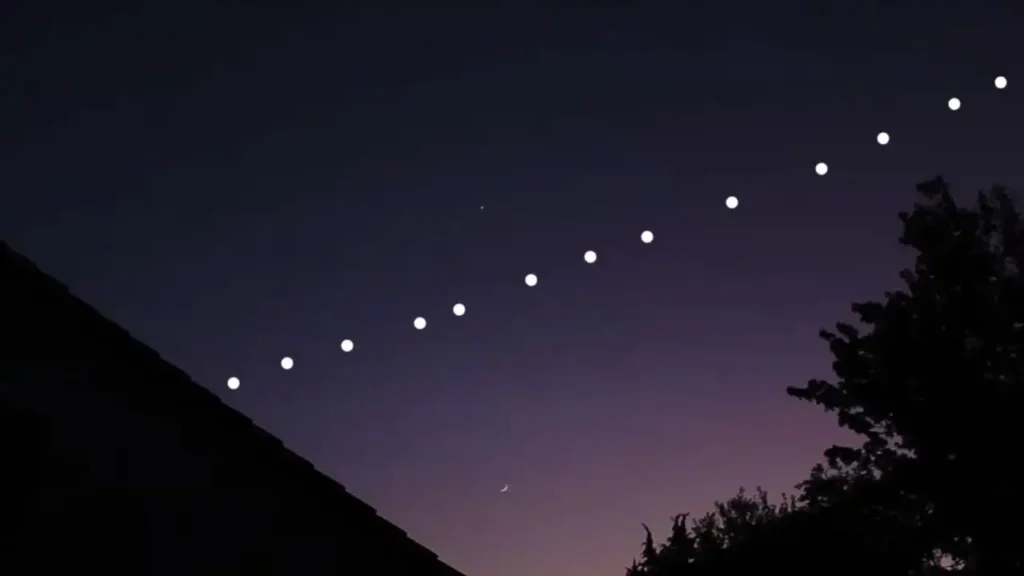
I was out walking my dog Sophie the other morning around 5 a.m. We’re both early risers. Countless stars filled the unusually clear sky. As Sophie sniffed traces who had passed our way overnight, I noticed something among the constellations that I’d never seen before. Without a doubt, what I thought I was seeing was influenced by the uncertain state of today’s world.
Returning to the house, I asked Grok:
What would explain a straight line of 20 or more high altitude aircraft lights each separated by about 2 degrees of the sky about 5 a.m. moving roughly from south to north? A military convoy?
Grok quickly answered:
Most likely a Starlink satellite “train”. SpaceX launches batches of 20 to 60 plus Starlink satellites at once. Right after deployment (typically visible for the first few days), they fly in a tight “train” formation in a low temporary orbit before spreading out. They appear as a perfect chain of white lights or string of pearls. These are best seen in twilight (just after sunset or before sunrise) when the satellites are still sunlit but the ground is dark. They reflect sunlight off their solar panels. They move fast and silently in a straight arc (no turns or wobbles) crossing the sky in a few minutes. Spacing is uniform, and there are no aircraft-style strobes or colored lights.
A military aircraft convoy/formation (e.g. C-17s or tankers in a conga line or echelon formation), on the other hand, can create a line of lights, but they usually have blinking navigation/anti-collision lights and aren’t perfectly evenly spaced. Large formations of 20+ are rare and not typically described with such geometric precision.
Whew! That was comforting. And here I was thinking I had witnessed the start of World War III or something equally ominous. Artificial intelligence must be given credit for settling me down before I had my morning coffee.
But that unnerving experience got me thinking about all the stuff up there orbiting the Earth at incredible speeds.
A Brief History of Space Satellites
The first manmade satellite to orbit the earth was, of course, the Soviet Union’s Sputnik 1 in 1957. As a child, I remember hearing the satellite’s “beep, beep, chirp” sound being reported by the news. This marked the beginning of the Space Age, as well as the technological boom which has transformed modern lives. Before then, the word “satellite” generally referred to a moon orbiting a planet, such as ours. It didn’t acquire its current meaning until NASA and other space programs began sending unmanned probes into the firmament to study what was there.
By 1980, only 130 satellites were said to be orbiting Earth, mostly having a scientific purpose. But it was well known that the military had others – what we called “spy satellites”. Even by 2000, only 700 to 1,000 satellites were supposedly up there. That number seemed low considering how common satellite TV, satellite radio, and satellite telecommunications had become[i].
By 2020, the number of satellites increased to somewhere between 2,600 and 3,400 devices. But the most impressive growth has happened during the past six years. Now, there are as many as 17,600 satellites overhead.[ii] Most of this increase was due to the introduction of reusable rockets like SpaceX’s Falcon 9. Surely, that staggering amount couldn’t have been achieved without “trains” of Starlink satellites being continuously launched. Elon Musk says he’s not done, however. Eventually, he hopes to build a “mega constellation” of 42,000 satellites.[iii]
Is There Enough Room?
I wondered whether an app was keeping track of all this satellite traffic. Not surprisingly, there is. In fact, there are several. I downloaded one called Satellite Tracker 3D which allows real time tracking of every object in Earth orbit and even some that have left Earth orbit. Frankly, I’m not sure I care to know how many objects are at risk of dropping from the sky at any moment.
I recently learned that a satellite needs a sustained velocity of approximately 17,500 miles per hour to stay in orbit, a speed that’s readily attainable by modern launch vehicles. However, a satellite’s orbital decay ultimately determines how long it stays up there. When a satellite descends below an altitude of 185 miles, the thin atmosphere produces enough friction to slow its speed causing it to fall rapidly to Earth. We’ve all heard recent reports of space junk hitting homes.[iv]
Equally important is how to keep a safe distance between satellites. Currently, there is no air traffic control in outer space. Individual satellite operators bear full responsibility for avoiding collisions. However, the U.S. Space Force’s 18th Space Defense Squadron has stepped in and established the world’s first sensor network for tracking over 45,000 orbital objects. The Space Force issues “conjunction data messages” (CDMs) to satellite operators whenever orbiting objects are at risk of getting too close. The European Union is also developing a satellite tracking service to diminish the reliance of its member states on the United States. If I owned and operated a satellite in space, I’d choose the Space Force’s network over the E.U.’s.
There’s also a satellite observing group on Face Book which sounds like fun – but I’ve never been much for getting up in the middle of the night to watch meteor showers, so maybe not. Given the number of satellites now in orbit, Wikipedia assures me that a 15-minute session of sky watching will yield at least one satellite passing overhead.
Why Satellites Matter
Why do these facts matter? Like many things nowadays, we’re constantly being told that humanity’s future will be in space. That’s probably true for those who will live to see the second half of the 21st century. But I’ll be happy just to see Mars colonized.
My life has already been enriched by satellites through Sirius XM radio. According to one of my favorite singer-songwriters, Bonnie Raitt:
“The world I live in is benefiting from things like satellite radio. Jazz and blues fests are everywhere now, and Americana is going strong. What I’m hearing is an appreciation of real music.”[v]
As someone who loves rural America more than its cities, it seems there will never be enough cell towers erected to prevent dropped calls. Maybe having a satellite phone is my future.
Finally, there’s something poetic about the idea of a satellite moving silently through space, using solar energy to do its work and connecting people with one another. I’m not the first to have noticed that. The 90s alternative/indie pop/rock band Guster had a minor hit with its song “Satellite” in 2006, which I will end with:
“Shining like a work of art
Hanging on a wall of stars
Are you what I think you are?
You’re my satellite
You’re riding with me tonight
Passenger side, lighting the sky
Always the first star I find
You’re my satellite”[vi]
[i] As late as 1961, the first news story about the building of the Berlin Wall had to be flown in on film before being aired on network TV. It was not until 1965, however, that TV reporter Daniel Schorr broadcast live from Berlin on Walter Cronkite’s evening news via a satellite link.
[ii] These satellites have originated from 40 nations using the launch capabilities of 10 different countries.
[iii] Tereza Pultarova, “Are Starlink satellites a grand innovation or an astronomical menace”, Space.com, June 1, 2026.
[iv] On Mark 8, 2024, a 1.6-pound metallic cylinder from the International Space Station plummeted through the roof of a home in Naples, Florida. The homeowner has filed an $80,000 claim against NASA for property damages, emotional distress and business interruption, according to The Guardian.
[v] Brainyquote.com.
[vi] From the Guster album “Ganging Up on the Sun”, written by Adam Gardner, Ryan Miller, Joe Pisapia, and Brian Rosneworcel, Reprise Records (2007).
Be First to Comment